


The main service disconnect is defined as the primary device that isolates a commercial building’s entire electrical supply from the utility source. Known formally in the National Electrical Code as the service disconnecting means, this device gives electrical engineers and facility managers a single point of control over incoming power. The role of main service disconnect commercial systems play goes far beyond convenience. NEC Article 230.71 limits the number of disconnects to six per building, and NEC 230.70 mandates placement near the service entrance. These two code requirements shape every commercial installation. Understanding both the code framework and the practical functions of this device is the foundation of safe commercial electrical design.
What is the role of main service disconnect in commercial systems?
The main service disconnect is the first and most critical switching point between the utility grid and a building’s internal electrical distribution. Every circuit, panel, and load inside the building sits downstream of this device. When it opens, power to the entire facility stops.
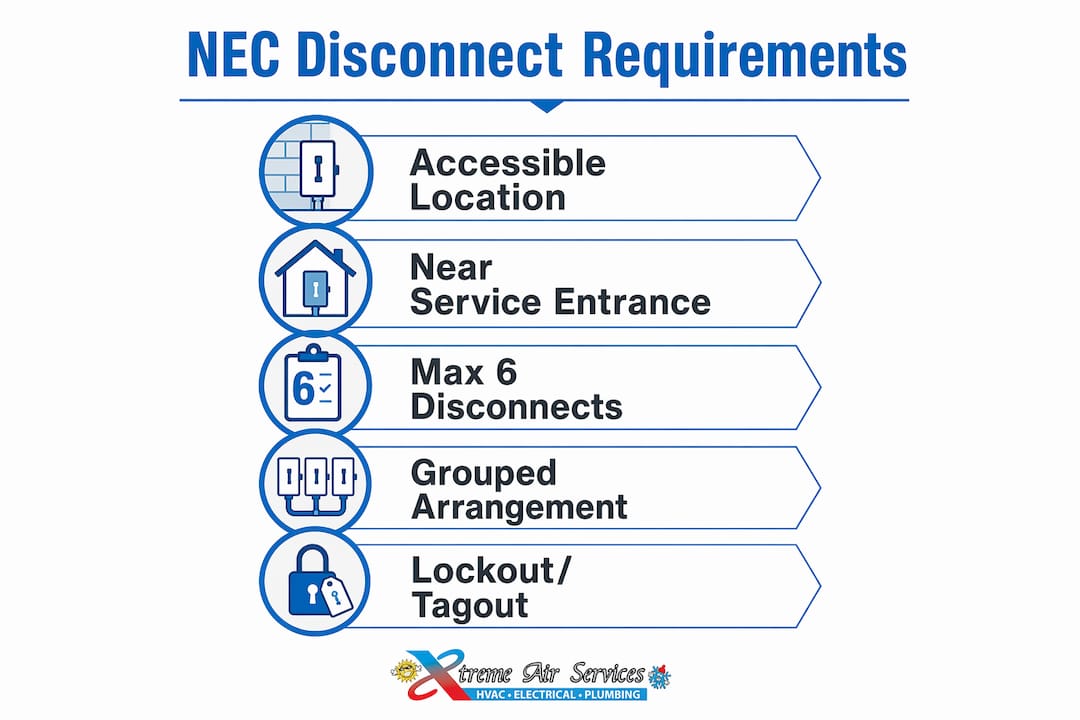
NEC 230.70 requires the disconnect to be installed at a readily accessible location near the point where service conductors enter the building. That placement is not arbitrary. It means firefighters, utility workers, and facility staff can reach the shutoff without entering energized spaces or navigating deep into the building.
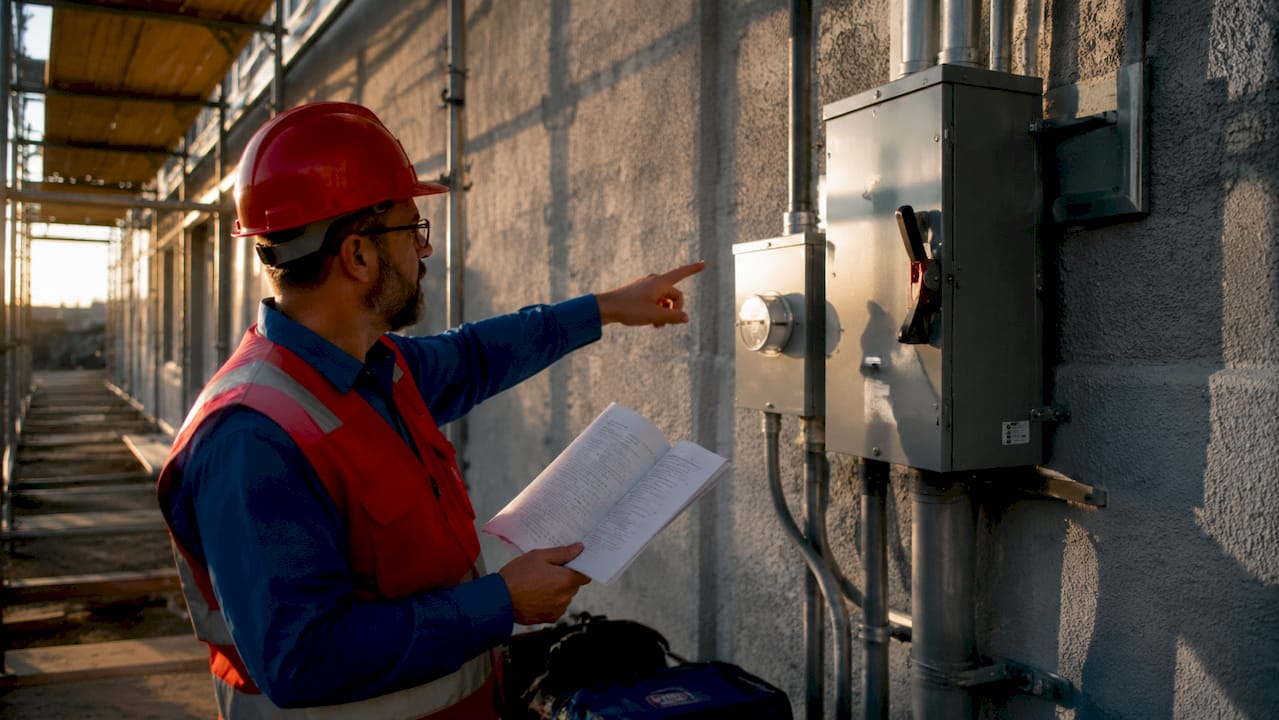
The NEC also recognizes that a single disconnect is not always practical for large commercial buildings. NEC 230.71 permits up to six disconnects grouped at one location to serve as the collective service disconnecting means. Each disconnect controls a portion of the load, but together they must be able to de-energize the entire building. This grouping rule is the foundation of what practitioners call the “six-handle rule.”
The main service disconnect also defines the legal boundary between utility-owned equipment and customer-owned equipment. Everything upstream of it belongs to the utility. Everything downstream belongs to the facility. That boundary determines who is responsible for maintenance, inspection, and fault response.
What NEC codes govern commercial service disconnects?
Code compliance for commercial service disconnects is not optional. The NEC sets specific rules for location, quantity, equipment ratings, and accessibility. Violating any of these creates both legal liability and genuine safety risk.
NEC 230.70 and 230.71: location and quantity
NEC 230.70 mandates that the service disconnecting means be accessible and located as close as practical to the point of entry of service conductors. For most commercial buildings, this means the disconnect appears at the exterior wall, in a dedicated electrical room adjacent to the service entrance, or in a meter room accessible from outside.
NEC 230.71 caps the number of service disconnects at six for any single building or structure. That limit exists to prevent a scenario where a first responder must locate and operate dozens of switches to de-energize a building under emergency conditions. Six is the maximum. Fewer is always better from a safety standpoint.
NEC 230.82 and AIC ratings
Equipment installed upstream of the service disconnect faces the highest available fault current in the entire system. NEC 230.82 requires that any equipment connected on the line side of the disconnect comply with specific listing requirements. The AIC (ampere interrupting capacity) rating of that equipment must exceed the available fault current at the service point.
Selecting equipment with an AIC rating matched to available utility fault current is critical. An undersized AIC rating means the equipment can fail catastrophically during a short-circuit event, potentially causing an arc flash or fire. Engineers must confirm available fault current with the utility before specifying equipment.
- Confirm available fault current with the serving utility before equipment selection.
- Verify that all line-side equipment carries an AIC rating that exceeds that fault current value.
- Confirm the disconnect location meets NEC 230.70 accessibility requirements.
- Verify the total number of disconnects does not exceed the NEC 230.71 limit of six.
- Ensure all equipment meets NEC 230.82 listing requirements for line-side installation.
Pro Tip: Request a written fault current study from the utility before finalizing equipment specifications. Utilities update their system configurations, and fault current values can change between the design phase and the construction phase of a project.
How does the main disconnect function as an emergency safety device?
The main service disconnect is the first tool emergency responders reach for when a commercial building has an electrical emergency. Its location near the service entrance is not just a code formality. It is a deliberate design choice that keeps first responders out of energized, potentially dangerous interior spaces.
Emergency power isolation
Fire, flooding, and electrical faults all create scenarios where power must be cut immediately. Emergency responders rely on the main disconnect to isolate power quickly, and the six-handle rule exists specifically to allow that shutdown under stress and poor visibility conditions. A firefighter in full gear, in a smoke-filled exterior corridor, can operate no more than six handles reliably. That physical constraint drove the NEC limit.
The decision to cut power is not always straightforward. Cutting power via the main disconnect during an emergency balances the risk of electrocution against the possible impact on critical building systems, including elevators, emergency lighting, and fire suppression controls. Facility managers should work with their local fire marshal to pre-plan which scenarios call for immediate full disconnection and which require a more staged shutdown.
Key emergency use cases for the main service disconnect include:
- Electrical fault or arc flash: Immediate isolation prevents fault current from continuing to flow and reduces arc flash energy.
- Fire involving electrical equipment: Cutting power removes the ignition source and allows firefighters to use water safely.
- Flooding or water intrusion near electrical equipment: Energized equipment in contact with water creates electrocution risk for occupants and responders.
- Utility-side fault requiring isolation: Utility crews may request the building disconnect to be opened before they work on the service conductors.
“The main service disconnect is the one device in a commercial building that every first responder, facility manager, and electrical engineer must be able to find and operate without hesitation. Its location, labeling, and accessibility are not design preferences. They are life-safety requirements.”
Lockout/tagout compliance
Lockout/tagout capabilities are required for service disconnect switches used during maintenance. OSHA’s lockout/tagout standard (29 CFR 1910.147) requires that energy sources be isolated and locked before any maintenance work begins on electrical equipment. A main service disconnect that cannot accept a padlock hasp does not meet this requirement. Facility managers must verify that their disconnect hardware supports lockout before scheduling any maintenance that requires de-energizing the service.
What are the common configurations for commercial main disconnects?
Commercial main service disconnect configurations range from a single main breaker to grouped multiple disconnects and meter-main combination units. Each configuration has distinct implications for installation cost, maintenance access, and code compliance.
Single main breaker vs. multiple disconnects
| Configuration | Best use case | Maintenance consideration |
|---|---|---|
| Single main breaker | Most commercial buildings with one service | Simplest to operate and inspect; one point of failure |
| Multiple grouped disconnects (up to six) | Large buildings with multiple service sections | Each disconnect must be labeled; all must be accessible |
| Meter-main combination unit | Smaller commercial buildings and pad-mount services | Meter and disconnect in one enclosure; utility access rules apply |
| Feeder disconnect | Downstream sub-panels, not the service entrance | Governed by NEC Article 225, not Article 230 |
The single main breaker is the most common configuration in mid-size commercial buildings. It provides one clear point of control and simplifies both emergency response and routine maintenance. Multiple grouped disconnects appear more often in large retail centers, industrial facilities, or buildings with multiple tenant services.
Engineers must distinguish service disconnects from feeder disconnects when designing and inspecting systems. A feeder disconnect controls power to a sub-panel or a specific load group. It does not serve as the service disconnecting means and does not fall under NEC Article 230. Applying Article 230 requirements to a feeder disconnect, or vice versa, creates compliance errors that can fail inspection.
Meter-main combination units integrate the utility meter socket and the service disconnect into a single enclosure. Meter-main combination equipment is permitted but must physically isolate the meter section from the disconnect section so utility personnel can access the meter without entering the customer’s equipment. Utility companies often have specific approval requirements for meter-main equipment, so confirm with the serving utility before specifying this configuration.
Pro Tip: Label every disconnect in a grouped arrangement with a permanent, weather-resistant tag identifying the load it controls. Generic labels like “Disconnect 1” create confusion during emergencies. Use specific descriptions like “North Wing Panels A and B” instead.
What are the best practices for maintaining commercial service disconnects?
Routine maintenance of the main service disconnect protects both the equipment and the people who depend on it. Neglected disconnects are a leading indicator of broader electrical system problems. Signs of electrical aging in a service disconnect, including noise, staining, and loose components, often point to systemic issues in the upstream distribution system.
Inspecting the main service disconnect can reveal hidden problems in the entire power distribution path. Discoloration around terminals indicates heat from a loose connection or sustained overload. Buzzing or crackling sounds suggest arcing inside the enclosure. Physical looseness in the handle mechanism means the disconnect may not fully open or close under load.
A practical inspection checklist for facility managers covers these areas:
- Visual inspection of the enclosure: Check for rust, moisture intrusion, physical damage, and missing knockouts.
- Terminal and connection tightness: Verify torque on all lugs and connections per manufacturer specifications.
- Thermal imaging: Use an infrared camera to identify hot spots at connections and bus bars without opening the enclosure under load.
- Operational test: Exercise the disconnect handle through its full range of motion to confirm smooth operation and positive latching.
- Labeling verification: Confirm all labels are legible, accurate, and permanently attached.
- Lockout/tagout hardware check: Verify that padlock hasps are present and functional.
Coordinating with the utility is a non-negotiable part of any maintenance that requires de-energizing the service. Utility providers require advance notice for service disconnection and reconnection, typically 24 hours, and reconnection requires a passing inspection before power is restored. Scheduling this coordination well in advance prevents costly delays, especially for facilities that cannot tolerate extended outages.
The most common maintenance mistake is deferring inspection because the disconnect “looks fine.” Thermal imaging consistently reveals hot spots at connections that show no visible signs of damage. A commercial HVAC preventive maintenance mindset, where you inspect on a schedule rather than waiting for failure, applies equally well to electrical service equipment.
Key Takeaways
The main service disconnect is the single most critical safety device in a commercial electrical system, and its proper installation, configuration, and maintenance directly determine how safely a building can be de-energized in any emergency.
| Point | Details |
|---|---|
| Code-defined location | NEC 230.70 requires the disconnect near the service entrance for fast, accessible operation. |
| Six-disconnect maximum | NEC 230.71 limits any building to six service disconnects, enabling quick shutdown under emergency conditions. |
| AIC rating compliance | Equipment upstream of the disconnect must carry an AIC rating exceeding available fault current per NEC 230.82. |
| Lockout/tagout requirement | Every main service disconnect must support padlock lockout to meet OSHA maintenance safety standards. |
| Maintenance reveals system health | Noise, staining, or loose components on the disconnect often indicate broader upstream electrical problems. |
What working with commercial disconnects has taught me
After years of working on commercial electrical systems across office buildings, retail centers, and industrial facilities, the pattern I see most often is this: the main service disconnect gets treated as an afterthought until something goes wrong.
Facility managers focus on the equipment that runs daily. HVAC units, lighting controls, and fire alarm panels get scheduled maintenance. The main service disconnect sits in its enclosure, untouched, until a fault or an emergency forces someone to operate it. That is exactly the wrong approach. A disconnect that has not been exercised in years may not open cleanly under load. A handle that sticks or a latch that does not engage fully can turn a routine shutdown into a dangerous situation.
The labeling issue is more serious than most engineers acknowledge. Clear, specific, permanent labels on every disconnect are not just a code requirement. They are the difference between a first responder cutting power in 30 seconds and spending three minutes reading faded tape labels in a smoke-filled room. I have seen facilities where the labels were printed on paper and taped inside the enclosure door. That is not acceptable for life-safety equipment.
The other thing I have learned is that the six-handle rule is a ceiling, not a target. If your building’s service can be controlled with one or two disconnects, use one or two. Every additional disconnect adds complexity, adds another point of potential failure, and adds another thing a first responder has to find and operate under stress. Simplicity is a safety feature.
— Xtreme
Xtremeairservices keeps your commercial electrical system compliant
Commercial electrical safety starts at the service entrance. Xtremeairservices provides expert installation, inspection, and maintenance of commercial electrical systems for facilities across the Dallas area, including main service disconnect upgrades, code compliance reviews, and full service entrance assessments.
Whether you are planning a new installation, upgrading aging equipment, or scheduling a maintenance inspection, the Xtremeairservices team brings the code knowledge and field experience your facility needs. Our electrical services in Dallas cover everything from NEC compliance checks to full service entrance replacements. Contact Xtremeairservices to schedule an assessment and confirm your main service disconnect meets current safety and code standards.
FAQ
What is the main service disconnect in a commercial building?
The main service disconnect is the device that isolates a commercial building’s entire electrical supply from the utility. NEC Article 230 governs its location, quantity, and equipment requirements.
How many service disconnects does NEC allow per building?
NEC 230.71 permits a maximum of six service disconnects per building, grouped at one location to allow complete de-energization of the facility.
Where must the main service disconnect be located?
NEC 230.70 requires the disconnect to be at a readily accessible location near the point where service conductors enter the building, so it can be reached quickly during emergencies.
What does AIC rating mean for service disconnect equipment?
AIC stands for ampere interrupting capacity. Equipment upstream of the service disconnect must carry an AIC rating that exceeds the available fault current at the service point, as required by NEC 230.82.
How often should a commercial main service disconnect be inspected?
Annual inspection is the standard practice for commercial service disconnects. Inspections should include a visual check, connection torque verification, thermal imaging, and an operational test of the disconnect handle.